How to Talk to Kids About Big Feelings (Without Dismissing Them)
“You’re fine.” “Calm down.” “There’s nothing to be scared of.” “Big kids don’t cry about that.”
We’ve all said some version of these phrases, usually when we’re exhausted, overwhelmed, or just trying to get through dinner. But here’s what I’ve learned: these well-meaning responses often make things worse.
When we dismiss or minimize our children’s feelings, we miss an opportunity. We miss the chance to help them understand their emotional world—a skill that will serve them for the rest of their lives.
The good news? It’s never too late to change how we talk about feelings. And it’s simpler than you might think.
Why Feelings Talk Matters So Much
Emotional intelligence isn’t just a nice-to-have—it’s foundational to mental health, relationships, academic success, and overall wellbeing. Children who can identify, express, and manage their emotions:
- Have stronger friendships and social skills
- Perform better academically
- Are more resilient in the face of challenges
- Have lower rates of anxiety and depression
- Develop healthier coping mechanisms
The way we respond to our children’s emotions in early childhood literally shapes how their brains wire for emotional regulation. We are, in many ways, building their emotional operating system.
The Problem with “You’re Fine”
When we tell a crying child “you’re fine,” we’re trying to help. We want them to feel better, to stop hurting, to know that everything is okay.
But from the child’s perspective, they’re not fine. They’re experiencing something real and big and overwhelming. When we contradict their internal experience, several things happen:
- They learn their feelings are wrong. If I feel scared but Mom says there’s nothing to be scared of, something must be wrong with me.
- They disconnect from themselves. They learn to distrust their own emotional signals.
- They stop sharing. If feelings get dismissed, why bother telling anyone?
- The emotion doesn’t go away. It just goes underground, sometimes coming out in other ways—behavior problems, physical symptoms, or explosions later.
Validation doesn’t mean agreeing that the fear is rational or that the problem is huge. It means acknowledging that the feeling is real.
The Validate-First Approach
Before problem-solving, teaching, or redirecting, try validation first. It sounds like:
- “You’re really upset about that.”
- “That was scary for you.”
- “It sounds like you’re feeling frustrated.”
- “I can see this is hard.”
Notice these aren’t questions. They’re observations that communicate: I see you. I hear you. Your feelings make sense.
Validation is like a magic key that opens the door to everything else. A child who feels heard is far more able to calm down, think clearly, and accept help.
Building a Feelings Vocabulary
Kids can’t express what they can’t name. Help them build a rich emotional vocabulary:
Start with the Basics
Young children can learn:
- Happy
- Sad
- Mad/Angry
- Scared
- Excited
Expand as They Grow
Older children can handle more nuance:
- Frustrated vs. angry
- Disappointed vs. sad
- Nervous vs. terrified
- Jealous, embarrassed, lonely, overwhelmed, confused
Ways to Teach Feelings Words
Name your own feelings out loud: “I’m feeling frustrated because this recipe isn’t working.” “I’m nervous about my meeting tomorrow.” “I’m so happy to see Grandma today!”
Use books: So many wonderful children’s books explore emotions. Read them and pause to discuss: “How do you think the character feels here?”
Feelings check-ins: At dinner or bedtime, ask: “What’s a feeling you had today?” Share yours too.
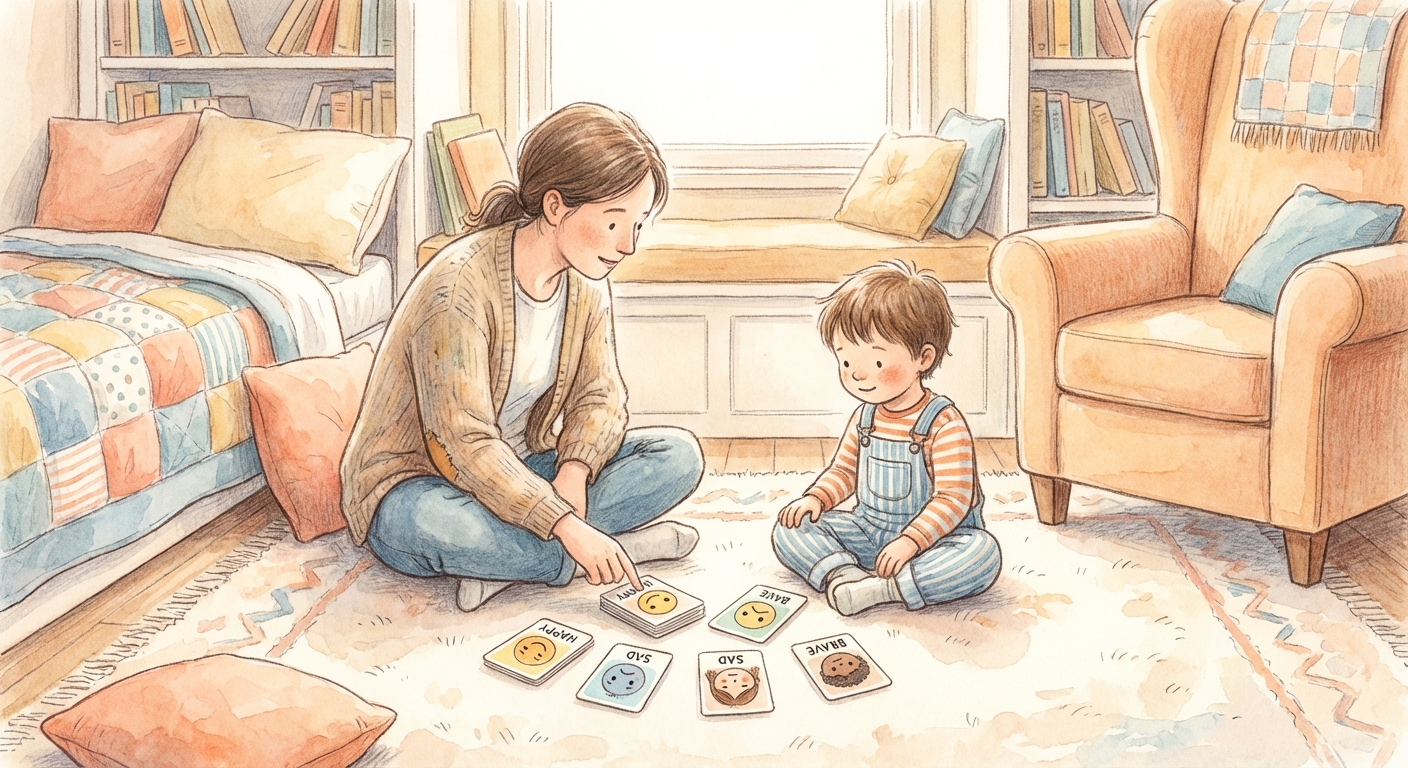
Feelings charts: Post a chart with faces showing different emotions. Reference it when discussing feelings.
Play the feelings game: “Can you show me what ‘surprised’ looks like on your face? Now try ‘worried.’”
Age-Appropriate Feelings Conversations
Toddlers and Preschoolers (2-5)
At this age, emotions are big, immediate, and physical. Toddlers feel with their whole bodies—that’s why tantrums are so explosive.
Keep it simple:
- Use basic feeling words: happy, sad, mad, scared
- Connect feelings to body sensations: “Your tummy feels wiggly when you’re nervous”
- Validate without fixing: “You’re mad that we can’t stay at the park”
Helpful phrases:
- “You’re feeling [emotion].”
- “That was really [hard/scary/frustrating] for you.”
- “I’m here with you.”
- “It’s okay to feel [emotion].”
Early Elementary (5-8)
Children this age are developing more emotional awareness but still need help making connections between events, feelings, and reactions.
Build understanding:
- Start exploring why feelings happen: “You felt embarrassed when you dropped your tray”
- Discuss the difference between feelings (always okay) and actions (not always okay): “It’s okay to feel mad, but it’s not okay to hit”
- Introduce coping strategies: “When you feel worried, you could take three deep breaths”
Helpful phrases:
- “What was happening right before you started feeling that way?”
- “What does [emotion] feel like in your body?”
- “What helped last time you felt this way?”
- “That sounds really tough. I understand why you’d feel that way.”
Tweens (9-12)
Pre-adolescence brings more complex emotions and a growing desire for independence. Kids this age may be less willing to share directly but still need emotional support.
Go deeper:
- Explore mixed emotions: “It sounds like you were excited AND nervous”
- Validate the complexity: “Feeling two things at once is confusing, isn’t it?”
- Share your own emotional experiences appropriately
- Give them language for social-emotional challenges
Helpful phrases:
- “Do you want advice, or do you just need me to listen?”
- “That’s a lot to handle.”
- “I’ve felt something similar when…”
- “What do you need from me right now?”
Scripts for Common Situations
When They’re Scared
Instead of: “There’s nothing to be scared of.” Try: “Something feels scary to you. Can you tell me more about it?”
Follow up with:
- “It’s okay to feel scared. Fear is trying to keep you safe.”
- “I’m here with you.”
- “What would help you feel braver?”
When They’re Angry
Instead of: “Stop yelling!” Try: “You are SO mad right now. I can hear it.”
Follow up with:
- “I’m listening.”
- “What happened?”
- “Let’s figure this out together when you’re ready.”
When They’re Sad
Instead of: “Cheer up!” Try: “I see the tears. Something is really making you sad.”
Follow up with:
- “I’m here.”
- “Do you want to tell me about it?”
- “It’s okay to cry. I’ll stay with you.”
When They’re Disappointed
Instead of: “It’s not a big deal.” Try: “You were really hoping for that, and it didn’t work out. That’s disappointing.”
Follow up with:
- “I get why you’re upset.”
- “It’s hard when things don’t go the way we wanted.”
- Sitting quietly together
When They’re Worried
Instead of: “Stop worrying.” Try: “Your brain is doing a lot of thinking about what might happen.”
Follow up with:
- “Worry is your brain trying to prepare you. But sometimes it overprepares.”
- “What’s the biggest worry right now?”
- “Let’s talk through what’s most likely to happen.”
What If They Won’t Talk?
Some kids aren’t talkers, especially as they get older. That’s okay. You can:
- Talk side-by-side rather than face-to-face (in the car, while walking, during a task)
- Use writing: Some kids express better in notes or journals
- Draw feelings: Ask them to draw how they feel
- Use media: “Have you ever felt like [character in a show/book]?”
- Share first: Sometimes modeling opens the door
- Wait: “I’m here when you’re ready. No pressure.”
And always remember: just being present is powerful, even without words.
Supporting Emotional Regulation
Naming feelings is step one. The next piece is helping kids learn to manage big emotions:
Create a Calm-Down Toolkit
Work together to identify strategies that help when feelings get overwhelming:
- Deep breathing
- A cozy corner with soft things
- Movement (jumping, running in place)
- Sensory tools (stress balls, putty)
- Natural calming aids like lavender or calming patches
- Music or headphones
- Drawing or art
Practice When Calm
Skills learned during meltdowns don’t stick. Practice breathing, mindfulness, and coping strategies when everyone is regulated. Then you can reference them in tough moments: “Want to try our balloon breathing?”
Co-Regulate
Young children can’t regulate alone—they need to borrow our calm. When they’re escalated, our steady presence helps them come down. This is called co-regulation, and it’s the foundation for self-regulation.
When Feelings Conversations Keep Getting Harder
Sometimes, despite our best efforts, children struggle significantly with emotions. Signs that might indicate a need for extra support:
- Intense emotions that last for hours
- Frequent meltdowns that seem disproportionate
- Difficulty recovering from emotional experiences
- Persistent anxiety, sadness, or worry
- Emotional struggles affecting daily functioning
If this sounds like your child, consider talking to your pediatrician or a child therapist. There’s no shame in getting support—it’s actually one of the bravest things a parent can do.
The Long Game
Every time you validate a feeling, you deposit into an emotional bank account. Over years, these deposits add up to a child who:
- Understands themselves
- Can express needs clearly
- Manages difficult emotions
- Builds healthy relationships
- Seeks help when struggling
That’s worth all the awkward conversations, all the pauses to validate when you’d rather just move on, all the times you bite back “you’re fine.”
You’re building something important. It matters. Keep going.
What’s the hardest part of feelings conversations for your family? What’s worked well? Share your experiences below—we’re all learning together.